Are We Preparing Students for the Decisions They'll Actually Have to Make?
Oct 05, 2026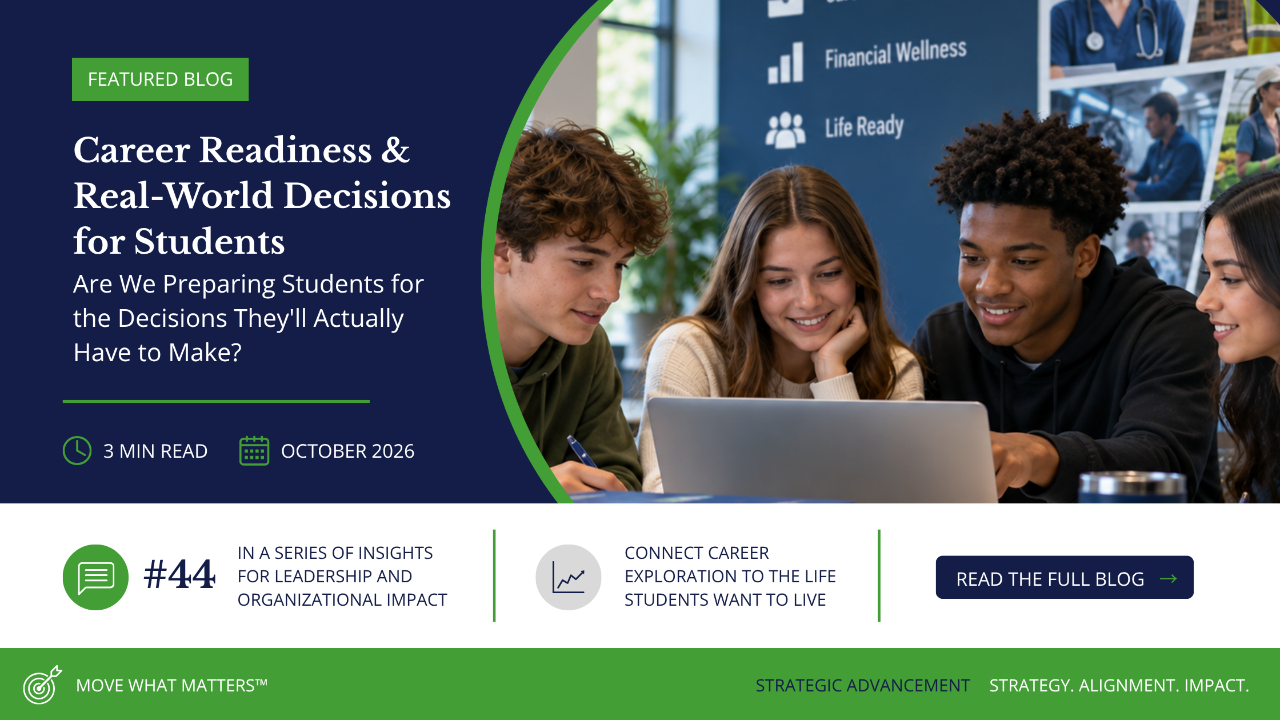
Executive Summary
Schools spend enormous time preparing students to demonstrate what they know.
But there is another question leadership teams should be asking:
Are students prepared to use what they know when the decisions become real?
Graduation is filled with decisions.
What career should I pursue?
Do I need college, a credential, an apprenticeship, or another pathway to get there?
What will that pathway cost?
What might I earn?
Where can I afford to live?
How much will transportation cost?
What happens when an unexpected expense appears?
And perhaps most importantly:
Will the choices I'm making help me build the life I actually want?
Financial literacy, career exploration, workforce readiness, communication, decision-making, and other readiness initiatives are often addressed separately in schools.
Students won't experience them separately.
Their careers will affect their finances. Their finances will influence their choices. Their choices will shape the lives they are able to build.
Preparing students for what comes next requires more than exposure to information. Students need opportunities to practice making interconnected decisions before the consequences become real.
This month's Move What Matters™ Executive Brief explores five ways leadership teams can move beyond checking the readiness box and begin creating learning experiences that better prepare students for life beyond graduation.
1. Readiness Is More Than a Requirement
Schools are accountable for ensuring students complete courses, earn credits, meet graduation requirements, and demonstrate academic proficiency.
Those things matter.
But completion and readiness aren't necessarily the same thing.
A student may successfully complete a financial literacy course and still struggle to build a realistic monthly budget.
A student may complete a career interest inventory without understanding what education or training their preferred career requires.
A student may identify a desired profession without knowing whether its starting salary will support the lifestyle they imagine.
That creates an important distinction for leadership teams.
Instead of asking only:
Did students complete it?
We should also be asking:
Can students use it?
True readiness requires opportunities to apply knowledge, evaluate choices, experience tradeoffs, solve problems, and adjust when circumstances change.
Leadership Insight
A requirement tells us what students completed. Readiness asks what students can actually do.
2. Close the Gap Between Knowing and Doing
Knowing the definition of a budget is different from having to live within one.
Understanding that emergencies cost money is different from discovering that the car needs a repair when rent is due.
Knowing that careers have different salaries is different from deciding whether the career you want will support the lifestyle you envision.
That is the knowing-doing gap.
Traditional instruction can provide students with important knowledge. But knowledge becomes significantly more powerful when students have opportunities to apply it.
Imagine students having to make choices about:
- Housing
- Transportation
- Food
- Insurance
- Education and training
- Credit and debt
- Savings
- Unexpected expenses
- Career decisions
- Lifestyle priorities
Suddenly, financial literacy becomes more than calculating percentages.
Career readiness becomes more than identifying an occupation.
Students begin experiencing how one decision affects another.
And when circumstances change, they have to reconsider their choices.
That's much closer to life.
Leadership Insight
Knowledge becomes valuable when students can use it to make a decision.
3. Make Learning Feel More Like Life
Some of the most meaningful learning happens when students stop asking:
"Is this going to be on the test?"
and start asking:
"What would I actually do?"
Authentic learning experiences give students a chance to wrestle with decisions that don't always have one correct answer.
Do I choose the apartment closer to work that costs more, or live farther away and pay for transportation?
Do I pursue additional education if it increases my earning potential but also creates debt?
What happens to my budget if my hours at work change?
Can I afford the lifestyle I imagined on the salary of the career I'm considering?
These are not simply financial literacy questions.
They require students to think critically, solve problems, communicate, prioritize, evaluate consequences, and make decisions.
Schools don't have to recreate adulthood for students.
But we can give them opportunities to practice adulthood while the stakes are still low.
Simulations, real-world scenarios, project-based experiences, industry partnerships, career-connected learning, and authentic decision-making can help students move from knowing concepts to navigating choices.
Leadership Insight
The closer learning gets to real decisions, the more clearly students can see why the learning matters.
4. Connect Career Exploration to the Life Students Want to Live
Students are often asked what career interests them.
They're also taught concepts like budgeting, saving, credit, debt, and financial planning.
But how often are those two conversations intentionally connected?
A career decision affects much more than a job title.
It can influence:
- Income
- Education and training costs
- Student debt
- Benefits
- Housing choices
- Transportation
- Geographic mobility
- Savings opportunities
- Family decisions
- Lifestyle
This creates an enormous opportunity for schools.
Career interest inventories don't have to end with:
"Here are five careers you might enjoy."
They can become the beginning of a much richer investigation.
If this is a career you're interested in:
What education or credentials will you need?
What will they cost?
What might your starting salary be?
Does compensation change depending on where you live?
What might housing cost in that community?
What will taxes and benefits mean for your take-home pay?
What kind of lifestyle could that income realistically support?
What tradeoffs might you have to make?
And then comes perhaps the most important question:
Does this pathway move you toward the life you want to build?
Now career exploration isn't an isolated activity.
It's connected to financial literacy, decision-making, goal setting, and life planning.
Leadership Insight
Career exploration becomes more meaningful when students can connect the work they might do to the life they want to build.
This connection between career exploration, earning potential, financial decisions, and lifestyle is also at the heart of our Living It™ Financial Literacy & Career Readiness work.
Explore Living It™ → link to updated landing page slug
5. Stop Preparing Students in Silos
Financial literacy.
Career readiness.
Workforce development.
Employability skills.
Communication.
Leadership.
Decision-making.
These may exist as separate initiatives, courses, programs, or departments inside an organization.
Students will experience them as one life.
A young adult deciding whether to accept a job offer may simultaneously need to understand compensation, benefits, transportation, housing, taxes, professional communication, budgeting, and long-term career opportunities.
Life doesn't separate those decisions into subject areas.
Our preparation shouldn't either.
This doesn't necessarily mean adding another program.
It may mean creating stronger connections among the work already happening.
Leadership teams can begin by mapping where students currently experience financial literacy, career exploration, workforce readiness, leadership, and other real-world skills.
Then ask:
Where could these experiences intersect?
That question may uncover opportunities for interdisciplinary learning, community partnerships, employer engagement, simulations, student projects, career experiences, and more meaningful applications of existing curriculum.
Leadership Insight
Students don't experience adulthood in subject-area silos. We shouldn't prepare them for it that way.
Design Backward From the Adult You Want Students to Become
There is another way leadership teams can approach readiness.
Instead of beginning with:
What program should we implement?
Begin with:
Who do we want our graduates to become?
Imagine one of your students five years after graduation.
What should they be able to navigate independently?
Perhaps they can:
Evaluate education and career pathways.
Understand a paycheck.
Build and adjust a budget.
Compare financial options.
Communicate professionally.
Evaluate risk.
Ask good questions.
Navigate an unexpected expense.
Recognize when they need help.
Make thoughtful tradeoffs.
Adjust when circumstances change.
Plan for something they want in the future.
Those outcomes give leadership teams something much more powerful than another checklist.
They provide a picture of readiness.
From there, schools can work backward and ask:
What experiences do students need today to become that adult tomorrow?
Ask Your Team These Five Questions
1. What decisions do we expect our graduates to be able to make independently?
Move beyond what students should know. Identify what they should actually be able to do.
2. Where are students practicing those decisions before the consequences are real?
Look across courses, programs, simulations, career experiences, extracurricular activities, and community partnerships.
3. How are we connecting career exploration to financial literacy?
Are students using career interests and inventories to explore income, education and training costs, lifestyle choices, and the financial realities associated with the careers they're considering?
4. Where could community, business, financial institution, and industry partners bring expertise, authentic experiences, or funding that makes this work possible?
Consider where students could learn directly from the people making these decisions every day.
5. How do we know students are leaving us prepared not just for their next step, but for the life they want to build?
This may be the most important question of all.
Final Leadership Thought
The goal isn't simply to prepare students to graduate.
It's to prepare them for what happens next.
Students will eventually make decisions about careers, education, money, housing, transportation, relationships, opportunities, and risk.
Those decisions won't happen independently.
One will influence another.
That means some of the most valuable experiences we can give students are opportunities to make decisions, experience consequences, reconsider their thinking, and try again while the stakes are still low.
We're not preparing students for a career and preparing them for life.
We're preparing them for one future where those decisions are deeply connected.
When schools help students connect what they're learning today with the lives they want to build tomorrow, we're doing more than preparing them to meet a requirement.
We're helping them move what matters.™
What Would Greater Student Readiness Look Like in Your Organization?
Financial literacy. Career exploration. Workforce preparation. Real-world learning.
Your organization may already be doing important work in each of these areas. The opportunity may be in how those experiences connect.
If your leadership team is thinking about how to create a more intentional approach to student readiness, let's start a conversation about what you're already doing, where the gaps may be, and what could have the greatest impact for students.
Schedule a Complimentary Strategy Conversation
Together, we'll explore where your organization is today, where you want students to go, and the experiences that can help bridge the gap.
Clarity. Capacity. Impact.
Move What Matters™