What Happens When the Classroom Gets Closer to the Real World?
Nov 01, 2026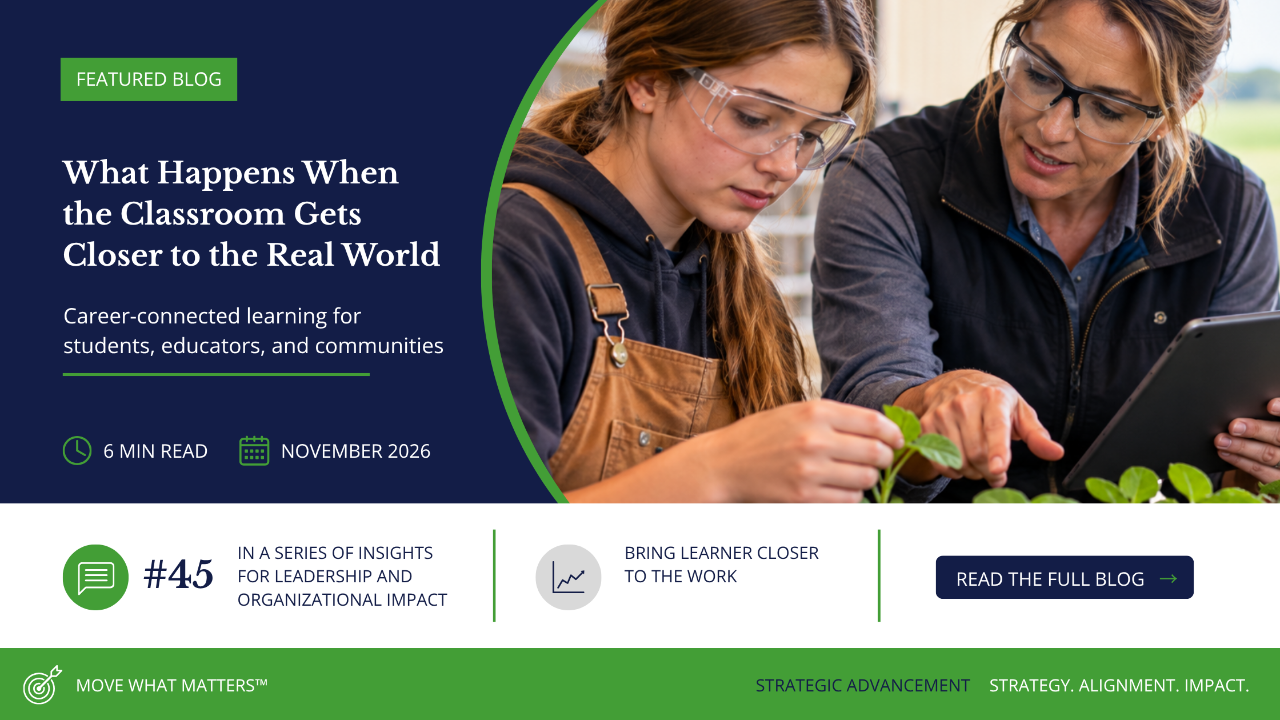
Executive Summary
Students are making decisions about careers, education, and their futures long before many have had meaningful opportunities to experience the world of work.
The leadership opportunity is to bring learning closer to the work. Students need to see possibilities, educators need practical context, and industry partners can help create authentic experiences.
Career readiness grows through exposure, practice, and relationships long before graduation.
1. Students Cannot Explore Opportunities They Do Not Know Exist
Ask students what careers exist in agriculture and many will understandably begin with farming.
But today's agriculture industry includes finance, technology, communications, logistics, data analytics, engineering, food science, animal health, sustainability, business management, skilled trades, and more.
The same visibility gap exists across many industries.
Students cannot seriously consider careers they have never encountered.
And awareness alone is not enough.
In our Mission Ag-Ready pre-survey, 84% of surveyed students had never written a cover letter, and 44% had never participated in a mock or real job interview.
Those numbers point to something bigger than two missing activities. They illustrate the distance that can exist between learning about a career and actually preparing to enter one.
Leadership Insight
Career readiness begins with exposure, but it grows through experience.
Schools do not have to turn classrooms into workplaces. They do need to create more opportunities for students to understand how learning connects to life beyond school.
2. Authentic Experience Changes the Conversation
There is an important difference between hearing about work and experiencing elements of it.
Consider this progression:
Hearing about the work → Seeing the work → Trying the work → Reflecting on the experience → Understanding the pathway
Each step gives students more information with which to make decisions.
An industry professional can explain a career.
A workplace visit can make that career visible.
An authentic business challenge can allow students to try the thinking required in that field.
A mentor can help a student understand the pathway.
And practicing a résumé, interview, presentation, or workplace decision gives students an opportunity to develop skills before those skills carry real consequences.
That is where career exploration begins to become career readiness.
3. Educators Need Access to the Real World, Too
We often talk about connecting students to industry. But there is another critical connection:
Educators need access to industry as well.
Teachers are being asked to prepare students for industries that are changing quickly. New technology, business models, workforce needs, and career pathways continue to emerge.
Our educator curriculum-review data reinforces the importance of giving teachers practical ways to make those connections.
60% of educator reviewers raised the need for more hands-on, tangible or non-screen learning.
That does not mean abandoning technology or academic content.
It means giving educators more ways to turn content into experience.
Industry-connected learning can help teachers answer questions students naturally ask:
- Why do I need to know this?
- Where would I use this?
- What kind of job actually does this?
- What would solving this problem look like in the real world?
When educators have stronger connections to industry, they are better positioned to create those connections for students.
Leadership Insight
If we want students to understand the world of work, educators need meaningful access to it too.
4. Industry Has More to Contribute Than a Job Posting
Industry partners are often invited into education at the end of the pipeline.
Attend a career fair.
Offer an internship.
Post available jobs.
But businesses can contribute much earlier.
Our industry curriculum-review data makes that especially clear.
94% of industry curriculum-review responses incorporated or called for authentic workplace applications, business information, cases, tools, data, or real-world experiences.
And 81% identified opportunities to bring industry directly into the learning experience through approaches such as guest speakers, mentors, site visits, industry organizations, and business partnerships.
That creates a much broader role for industry.
Businesses can contribute:
Expertise. People. Problems. Technology. Data. Mentorship. Workplace exposure. Career pathways. Experiences. Connections.
Sometimes they can also help fund the infrastructure that makes those experiences possible.
The question shifts from:
“Will you hire our graduates?”
to:
“How might we help students understand your industry before they ever apply?”
That is a fundamentally different workforce conversation.
There is another question leaders and industry partners should ask:
“How can we help make these experiences possible?”
The answer is not always another school-funded program. Businesses, associations, foundations, universities, workforce organizations, and community partners can help fund access, share expertise, create authentic experiences, and scale opportunities across multiple schools or communities.
That shifts partnership from a one-time request for help to a shared investment in the future workforce.
A business may sponsor one educator. A larger partner may help open access for a group of classrooms, a regional cohort, or multiple communities. Others may contribute expertise, people, technology, workplace experiences, or authentic problems students can learn from.
The goal is not simply to ask industry to support education.
It is to create a meaningful way for industry to help shape the future workforce.
5. The Workforce Pipeline Begins Before the Application
Workforce development is often discussed as though it begins when someone starts looking for a job.
It begins much earlier.
A stronger pathway looks something like this:
Exposure → Experience → Education & Skills → Relationships → Pathways → Workforce
Schools cannot build that pipeline alone.
Neither can employers.
It requires an ecosystem:
Schools + Educators + Industry + Community Partners
working together to create:
Awareness → Experience → Skills → Pathways → Workforce
Agriculture provides an especially powerful example because it sits at the intersection of science, technology, business, skilled trades, sustainability, food systems, finance, and community.
But the leadership principle reaches far beyond agriculture.
Leadership Insight
The strongest workforce pipelines are not recruitment strategies. They are relationship strategies built over time.
Ask Your Team These Five Questions
- Where are students currently getting authentic exposure to careers and industries?
- How often do students get to practice real workplace skills before graduation?
- How are we helping educators understand the industries and career pathways they are preparing students to enter?
- Are our business partners primarily helping us at the end of the pipeline, or are they helping shape experiences earlier?
- What is one place where we could bring the classroom closer to the real world this year?
Final Leadership Thought
Students do not need to have their futures figured out before they graduate.
They do need opportunities to discover what is possible.
That requires more than telling students about careers.
It means allowing them to see the work.
Try the work.
Meet the people doing the work.
Practice the skills.
Solve authentic problems.
And understand the pathways that can take them from where they are today to where they may want to go tomorrow.
Our student, educator, and industry data are telling us something remarkably consistent:
Different perspectives. One clear opportunity. Bring learning closer to the work.
When schools, educators, industry, and community partners build those connections together, career readiness becomes more than a program.
It becomes part of how students experience learning.
Ready to Move What Matters?
If your district, organization, or industry partnership is exploring how to strengthen career-connected learning, workforce readiness, or school-industry partnerships, let’s start with a strategy conversation.
We can look at where you are now, where stronger connections could make the greatest difference, and what a practical next step could look like.